


For everyday urban use, long-distance cycle touring, or even mountain biking or road cycling, a bike rack is incredibly useful. It allows you to carry more or less heavy loads that would quickly become uncomfortable in a backpack, and to secure them. It can also be converted into a support for fitting a child seat!
Bike rack specifications
- Types of rack: front (fork-mounted) and/or rear (frame-mounted, seat post or seat stay-mounted)
- Shapes: simple platform, platform with retaining clip, with mounting rails, with pannier support
- Materials: wood, aluminium, steel and titanium
EVERYTHING YOU NEED TO KNOW ABOUT BIKE RACKS
Types of bike racks
For the front
Mounted at the front, a rack can be attached around the wheel axle, via eyelets (threaded holes) if the fork has them, or directly around the fork legs using special clamps.
For the rear
Any eyelets present on the frame can be used to secure the rack. Some models also make use of the rear wheel axle to anchor very firmly.
When the frame shape makes fitting a standard rack difficult or even impossible, it is possible to use a model designed to clamp around the seat post or even the seat stays using adjustable clamps.
Shapes of bike racks
Simple platform
This very minimalist model gives you the freedom to secure your belongings however you like, most often with elastic straps.
Platform with spring-loaded retaining clip
Here, a clip is integrated and makes securing your load easier. Straps can always be used in addition!
Platform with pannier support
These racks are recognisable by their structure designed to keep panniers upright and prevent them from rubbing against the wheel.
Materials
Wood
Aesthetically pleasing and original, wood proves to be poorly suited to bike racks due to its low resistance in this application.
Titanium
Combining extreme lightness with outstanding strength, this material is reserved for the most demanding users due to its very high price.
Aluminium
Unaffected by rust, aluminium proves to be durable and resistant when used in bike racks, in the form of solid tubes. It generally supports loads of up to 20/25 kg.
Steel
At equal strength to aluminium, steel is thinner. For bike racks, manufacturers can work it in the form of hollow tubes. Steel then regains the advantage in terms of weight! Well suited to carrying heavy loads (up to 40 kg) and easily repairable, steel does however require careful maintenance to prevent rust.
Which bike rack should you choose?
While it is nowadays almost always possible to find a rack compatible with your bike, a few precautions are needed to make the right choice. Rack dimensions are not standardised. Manufacturers specify compatible wheel and tyre sizes.
In mountain biking, frame or fork mounting eyelets are very rare. The best solution is then to choose a simple and robust rack designed to be attached to the seat post or the seat stays.
For everyday city cycling, it is likely that all the mounting threads are already in place. Or better still, that the bike comes with a rack fitted as standard!
For road cycling, a lightweight rack will limit the added weight of the bike.
When it comes to loading, it is always advisable to distribute the weight carried as evenly as possible. If possible, try to use both a front and a rear rack. You will feel less imbalance and the handling you are used to with your bike will be less affected.
In all cases, limiting the load as much as possible helps preserve the full manoeuvrability of your bike. Loss of grip on climbs, speed wobble on descents, and exaggerated rolling motion in corners are just some of the sensations you may experience with a centre of gravity that is too high. To avoid these, it is recommended not to exceed 15 to 20 kg of load, even if the racks and your bike can support considerably more!
Of course, for long-distance cycle touring, a heavier load is sometimes necessary. In that case, choose reinforced, rigid racks, and do not load more than 25–30 kg on the rear wheel. If you opt for rail racks capable of accommodating panniers in a low position, the centre of gravity will be kept as close to the ground as possible and the load will unbalance you less.
Finally, don't forget to check how easy the rack is to install. For light or occasional use, tool-free installation models may be a wise choice. Moreover, they do not require threaded holes in the frame or fork.
If you are planning to fit a child seat, check the dimensions provided by the manufacturer to ensure compatibility with your bike and the rack.
Découvrez tous nos conseils & Tutoriels
ACCESSORIES - Bike Racks
-


THULE Pannier Mount for PACK'N PEDAL TOUR RACK
Regular price 29,99 €Regular priceUnit price perRecommended price* : 39,95 €
-


ZEFAL RAIDER R70 Pannier Rack
Regular price 69,99 €Regular priceUnit price perRecommended price* : 89,95 €
-

TOPEAK UNI SUPER TOURIST DX DISC Rack
Regular price 62,99 €Regular priceUnit price perRecommended price* : 64,99 €
-


TOPEAK TETRARACK M2 HD MTB Rack Black
Regular price 114,90 €Regular priceUnit price perRecommended price* : 129,99 €
-

TOPEAK TETRARACK R2-REAR Road Rack Black
Regular price 89,99 €Regular priceUnit price perRecommended price* : 109,99 €
-

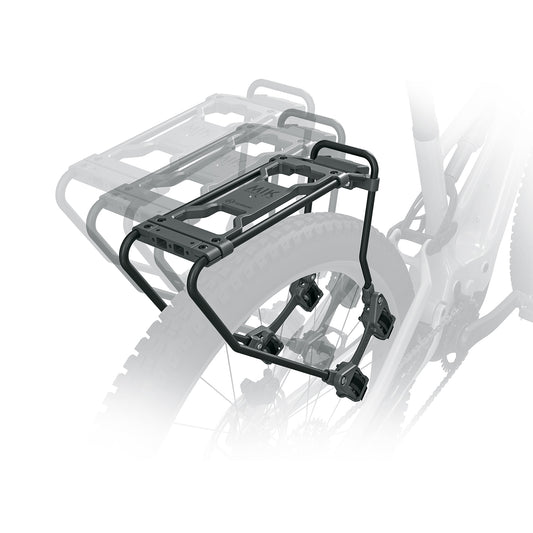
SKS GERMANY INFINITY MIK Universal Rack
Regular price 98,99 €Regular priceUnit price perRecommended price* : 109,99 €
-


ORTLIEB QUICK RACK XL Bike Rack Black
Regular price 109,90 €Regular priceUnit price per -


ORTLIEB QUICK RACK Stay Adapter for Pannier Rack
Regular price 15,99 €Regular priceUnit price per


