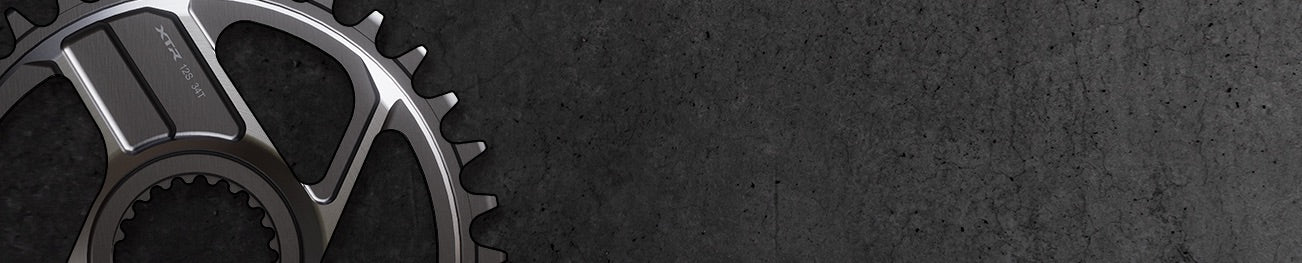
Changing the chainring is the simplest way to adapt your gearing to the terrain, for a few tens of euros. SRAM, Shimano, Race Face and e*thirteen cover both single and double chainring setups.
Direct Mount or bolt-on chainring?
Direct Mount : the chainring mounts directly to the crank arm, without a spider. Each brand has its own interface — SRAM, Shimano and Race Face Cinch are not interchangeable.
4-bolt 104 mm : the most common bolt circle diameter on spider MTB cranksets.
4-bolt 96 mm : used by several recent Shimano cranksets.
Check your crankset reference before ordering: it determines the interface.
What is a narrow-wide chainring?
Its teeth alternate between wide and narrow to fit the chain links. This is what keeps the chain in place on a single-chainring setup, without a front derailleur. Combined with a clutch rear derailleur, it makes a chain guide optional for most uses.
How many teeth?
30 to 32 teeth : the versatile standard for trail and all-mountain riding.
28 to 30 teeth : very steep terrain, loaded MTB riding, smaller riders.
34 to 38 teeth : fast cross-country and marathon riding.
On e-MTBs, the chainring is often smaller, as the motor compensates for the gearing.
Offset and material
Theoffset (0 mm, 3 mm, 6 mm) adjusts the chainline: it must match your Boost or non-Boost standard.
Steel : highly durable, the best lifespan-to-price ratio, slightly heavier.
Aluminium : lighter, wears faster in muddy conditions.
Replace the chainring and chain together when the teeth become hooked.